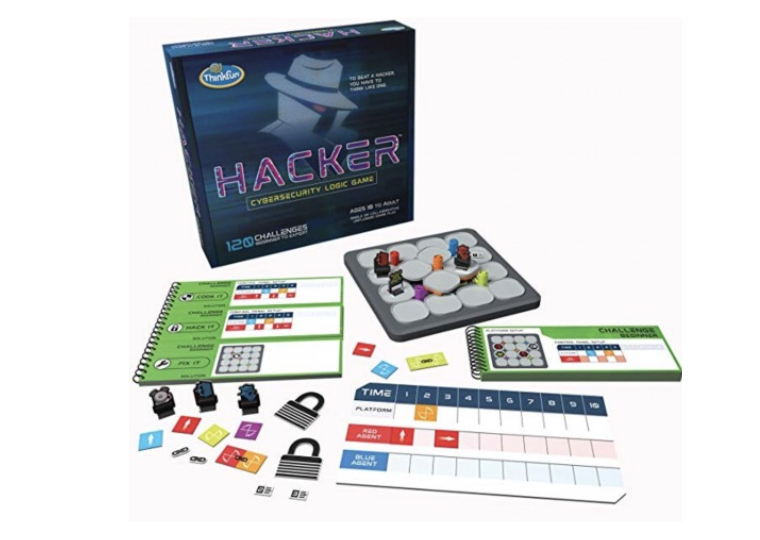
HACKER by its very name connotes a board game that doesn’t follow the “normal” set of rules. As designed by ThinkFun, this board game eschews all aspects of the online world to recreate the working environment that goes on inside of a computer. Because hackers go out of their way to attack programs that are being created and so these two. — programmers and hackers — are locked into an eternal battle of creating/degradation. This has also resulted in the creation of the security consultant, whose only job is to shut down the hacker for the programmer. This might seem “heavy” for children who are to play a board game — but the reality is that in today’s world, children already know what programmers and hackers are. So the game has a built-in audience who re readily disposed to wanting to be a programmer and yet also (for the fun of it) be the “dastardly” hacker. And if the child already knows that they are going to be learning bout programming and logic aspects during game play, the game’s design aids in muting any negative connotations that could have resulted.
Challenges Worth Taking On
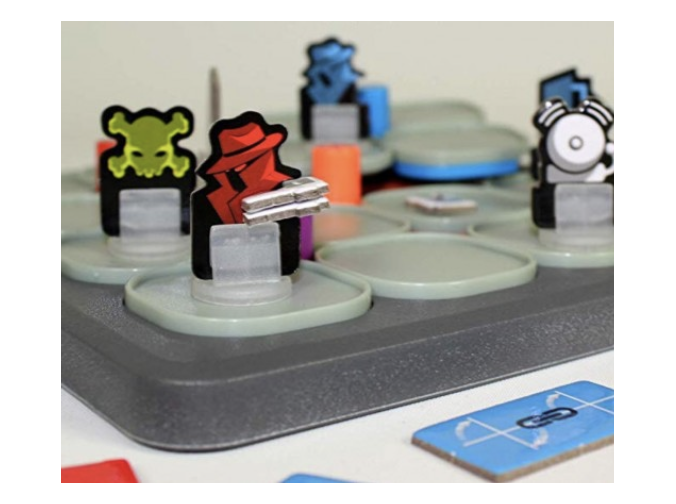
Being a board game, there is obvious a board that you physically place objects on to play with. But a better description is needed here as the board (or known here as the game grid) doesn’t consist of text and signage painted upon it. Instead what you have are 4 trays, each interlocking with the other and which has platforms on it. These platforms change position as you rotate the tray, and each rotated tray changes its position in relation to the other trays as a result. Upon the trays will be placed tokens representing different aspects of the cyber-world, fo example a file folder a virus and an alarm.
Designed for ages 10 and up, and for 1 player, the player will be taking on one of three roles: they can play the programmer who creates programs; they can play the Hacker who strives to disrupt programs; they can play the security consultant whose job it is to disrupt the hackers successful messing up of a program. All three roles require moving the trays (and tokens as a result) in the necessary sequence that will result in accomplishing a given task. Enabling this comes from the arrow cards that create the pathways of movement for the tasks at hand. These tasks or in the form of puzzles created by the game. They are found by using the Control Panel, which allows the assembly of sequences through the use of game tiles — these tiles control how the trays move, how the tokens interact with the movement and their location.
The puzzles (aka challenges) comes in the form of 120 of them (fond in the Challenge booklet) that range from beginner to expert Each challenge consists of 3 levels, with the first being the Chang to assemble and launch a program successful: this is visualized as being an agent on the game grid who is moved about in search of the exit door — and who must be kept from encountering hazards. The second level turns the player from programmer to hacker and now the timing of the program must be manipulated to have the agent end up encountering a virus. The final level has the security consultant — make that security engineer since it’s not a passive role but one requiring hands-on actions — come in to block the program so that the agent is kept from the virus (i.e., the program is kept from being infected by the virus). As can be seen, this is not the type of game that doesn’t require some thought.
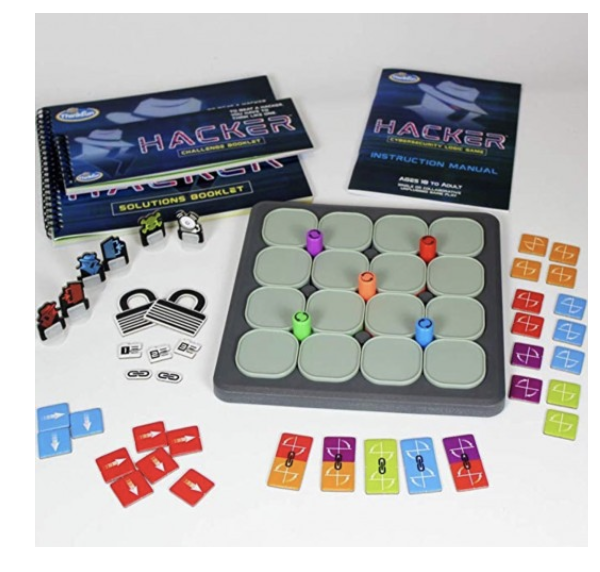
As can be seen, this is not the type of game that doesn’t require some thought and careful play — regardless of age, a series of events must occur for success to be reached. The bright colors used in the game and the visceral tactile sensations of the tokens and cards, combined with the need to think logically all come into play to create an educational experience. One that is disguised as fun, but fun with a purpose. And the inclusion of the Solution booklet avoids any deep frustration that the child might run into during/after game play (not to mention the parent supervising or playing along). ThinkFun’s HACKER provides a fun yet educational experience that promotes programming logic, STEM learning and logic and problem solving. But it’s thanks to a clever implementation of the game play that it is able to avoid seeming a “brainy” game that would turn off a child (or an adult either). So the parent who is playing along doesn’t have to constantly be explaining the game or making excuses for why they should be playing it. And as ThinkFun usually does, the price of the game is a mild $29.99, but doesn’t incur a negative result in the quality of the various parts of the game’s construction.


_final_20260515-1-1024x1024.jpg)